
EAST HADDAM
LOCATION: Two Wrasslin’ Cats Cafe
374 Town St, East Haddam, CT 06423
ARTIST: Jac Lahav and Aliyah Lacombe
CREATION DATE: 2023
ABOUT THE MURAL AND LOCAL HISTORY
This community mural was funded last September through grassroots fundraising, with support from local artists and community members, Public Art for Racial Justice Education (PARJE), and a matching grant from Sustainable Connecticut.
Cafe owner Mark Thiede originally envisioned a wall depicting people walking hand in hand with children. Artists Jac Lahav and Aliyah Lacomb expanded that vision by weaving together stories from East Haddam's history. The nearby East Haddam Historical Society Museum was invaluable in helping us research and tell many of these local stories.
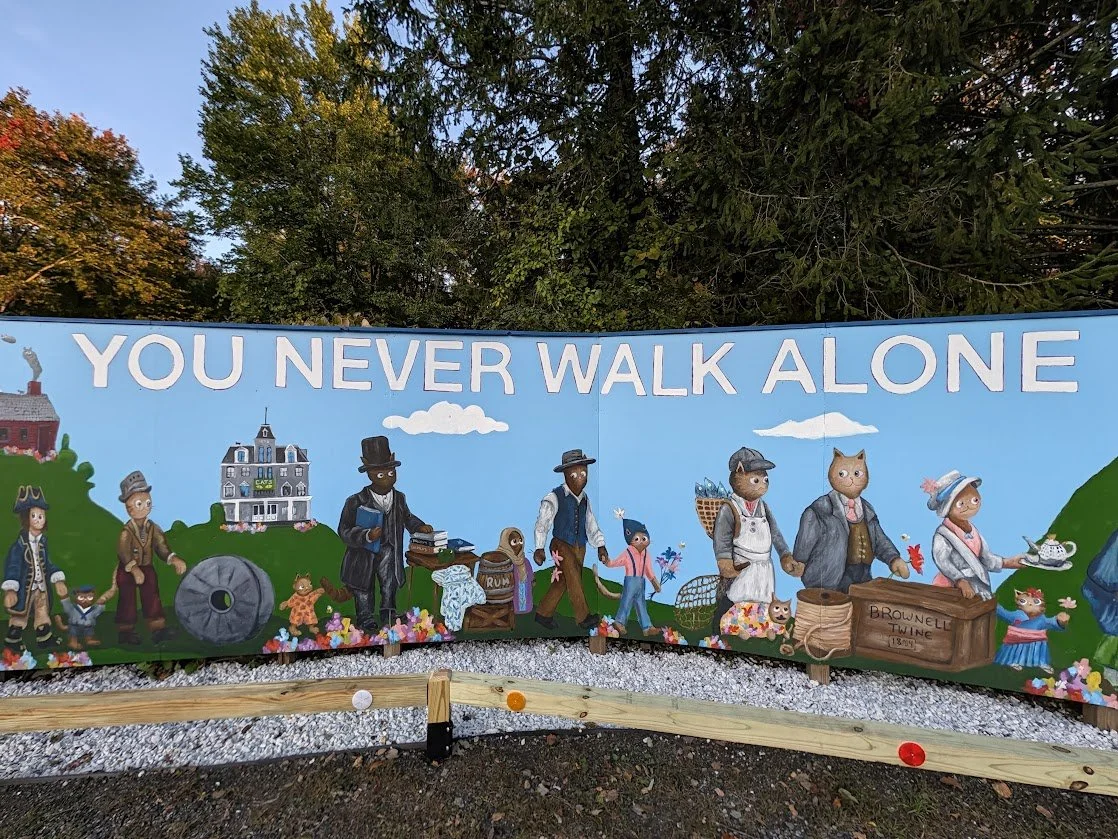
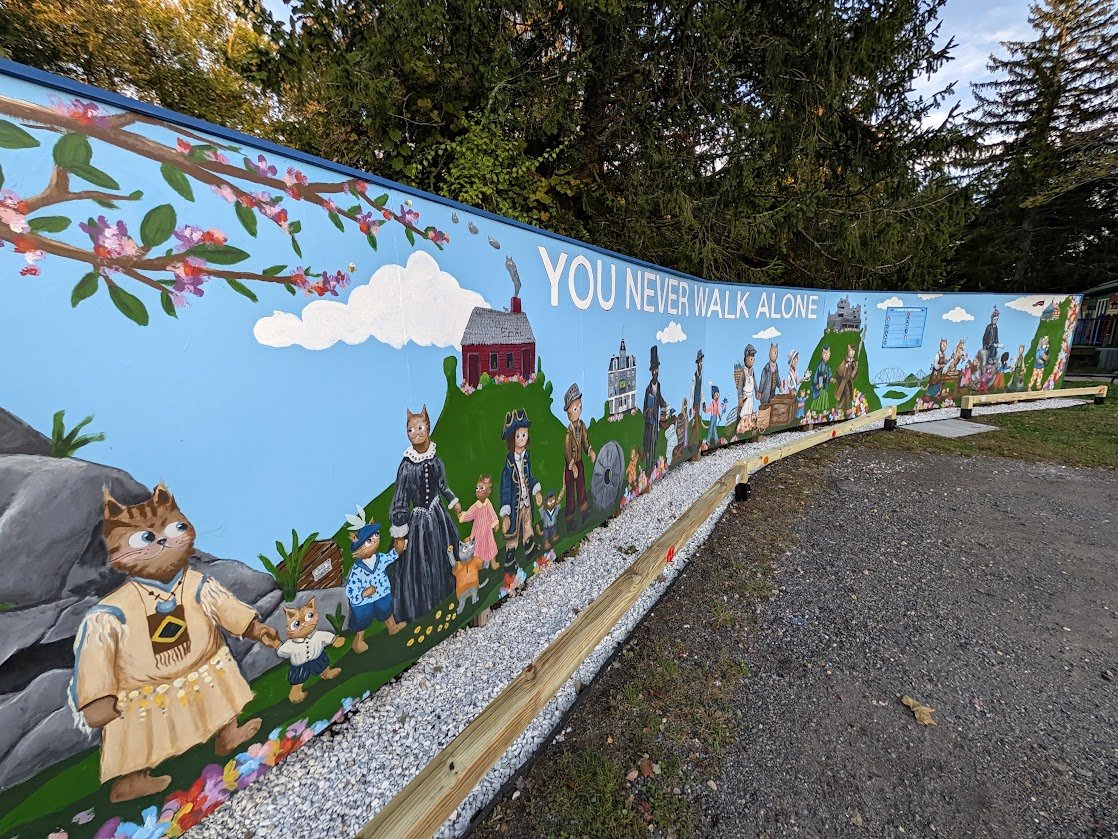
Reading from left to right, the mural presents a timeline of the area's history.
It begins with images of stone tools and arrowheads, reflecting the region's early Paleoindigenous history. In fact, a Paleoindigenous archaeological site was discovered in the cafe's backyard. The Native figure, dressed in white, wears a contemporary interpretation of Wangunk clothing. The Wangunk Tribe was an Algonquian-speaking indigenous people of the lower Connecticut River Valley, whose traditional homeland included present-day East Haddam, Haddam, Middletown, and Portland. While the Wangunk are the tribe most closely associated with this area, the land that became East Haddam was primarily used by many Indigenous peoples as hunting grounds.
The woman in black represents Sarah Ackley Gelston, one of the area's earliest settlers. Early colonists acquired the land from Native peoples in exchange for thirty coats; however, the lore says they removed the buttons before handing the coats over. That story is referenced by the crate labeled "30 Coats" and the scattered buttons at Gelston's feet. Throughout the mural we are trying to tell history honestly, exploring the good and the bad, the joyful and the painful, and the complicated stories that shaped this community.
Next is Nathan Hale, shown with his schoolhouse on the hill behind him. Before becoming one of America's most celebrated Revolutionary War spies, Hale taught school in East Haddam.
Following Hale is Dr. Abner Beebe, walking beside a millstone. A Loyalist during the Revolutionary era, Beebe was accused of sympathy toward the British. He was tarred and feathered by a mob, and his mill was destroyed, with its millstone reportedly thrown over the falls. His story raises enduring questions about political disagreement, public punishment, and how communities respond to those with opposing beliefs.
Next comes David Ruggles in his signature top hat. Born in Lyme and raised in Norwich, Ruggles became the first Black publisher and the first Black man to own a bookstore in the United States, located in lower Manhattan. He played a pivotal role in the Underground Railroad and helped Frederick Douglass after his escape from slavery. Douglass later married Anna Murray in Ruggles' home. While Douglass is a household name, David Ruggles deserves far greater recognition.
Next is Venture Smith, an enslaved African who purchased his own freedom and eventually established a successful life for himself and his family in East Haddam. When he was first sold into slavery, he was purchased for four gallons of rum and a piece of calico. This was the price of a human life and is represented by the objects beside him. Smith's autobiography remains one of the most important first-person accounts of slavery in early America.
Following Smith are Joseph Shea, representing the local fishnet industry, and Edward Brownell, whose 1825 twine company later pioneered the use of nylon in the 1950’s. Fishing, rope making, and manufacturing played an important role in East Haddam's economy for generations.
Next is Alice Hamilton, no relation to Alexander Hamilton. Her pioneering work documenting industrial diseases helped lay the foundation for modern workplace safety standards and eventually influenced what became OSHA. The teapot she carries is based on an object in the East Haddam Historical Society Museum's collection.
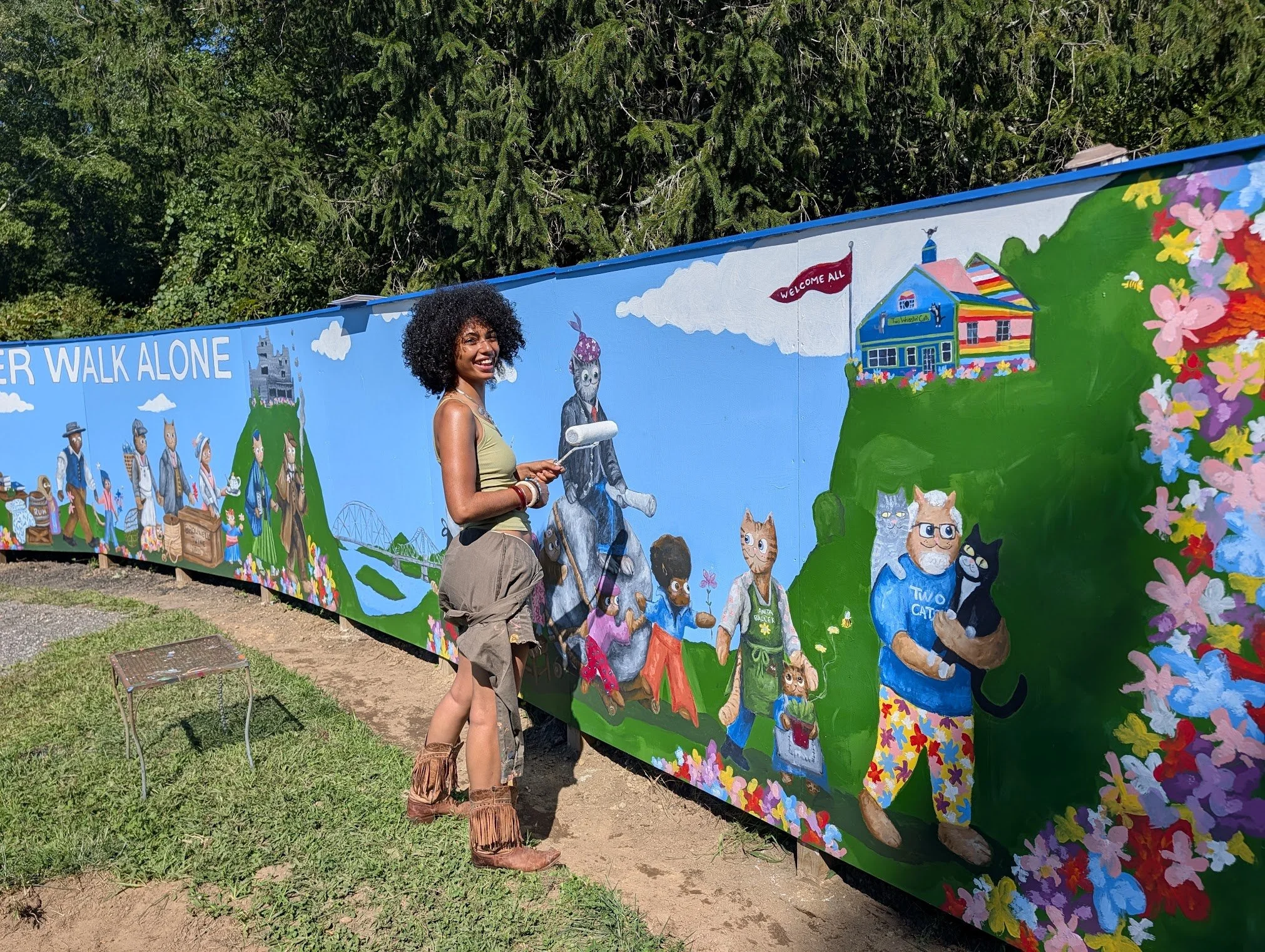
The mural then reaches the iconic Gillette Castle. William Gillette, famous for portraying Sherlock Holmes on stage, made East Haddam his home. After the death of his wife, he hired a Japanese man named Osaki, who became his chauffeur and close companion. Gillette was also famously devoted to cats.
East Haddam has a rich artistic tradition as well. Barbara Gilmour Stone is represented through her remarkable wood carvings, including the unicorn relief that is still preserved at the historical museum.
Nearby is sculptor Heinz Warneke, one of the town's most accomplished artists. The figures moving a massive boulder reference one of his sculptures and speak to a broader idea embraced by the cafe: meaningful change happens when people work together.
Anita Ballek, founder of Ballek's Garden Center, represents another important chapter in East Haddam's story. After generations of dairy farming, she transformed her family's farm into one of Connecticut's best known garden centers while becoming a respected advocate for conservation, smart land use, and community stewardship.
Finally, we arrive at Mark Thiede, holding his two cats, Larry and Bruno. Since opening Two Wrasslin' Cats, Mark has created one of the most welcoming and inclusive gathering places in the region, known for its support of the LGBTQ+ community, local artists, and animal welfare. The cafe has become a sanctuary for cats and, through donations and community events, raised more than $20,000 for animal shelters last year.